Walking along the length of the train, I tried to count the number of cars but got distracted by all of the activity on the boarding platform: a woman carrying at least 60 loaves of bread on her head, people asking me to carry my bags, Tanzanian music being blasted over loudspeakers. When I finally got a moment to concentrate, I estimated that the train was 25 cars long, and at least as many years old.
The brakes were squeaky, the suspension on most of the train was shot, and even though we were in a first class train car, the bunk beds were practically worn down to the springs. Miraculously, the train left exactly as it was scheduled at 4 pm (this level of punctuality is almost never experienced in East Africa). As the train rolled out of the train station, it passed through some of the poorest parts of Dar es Salaam. This video was taken in the first 20 minutes of the train ride in Dar es Salaam. In it, you will see a series of soccer fields interspersed with piles of trash, factories, and a busy road.
After only about a half an hour, the train had left Dar es Salaam in the dust. The soccer fields and factories gave way to a lush landscape of banana plantations and forest. In Dar es Salaam the houses had been made of cement bricks with corrugated iron roofs but here they were made of clay, wood, and thatch. As the train moved away from the ocean and the landscape got drier, the train started to pick up large quantities of dust. Soon, every exposed surface inside and outside of the train had a thin film of dust collected on it, including ourselves.
As the night set in, the train guards came around to tell us how to protect our belongings from thieves. They told us that thieves frequently climb on the top of the train looking for open windows. One thief will hold the ankles of another as he dangles down the side of the train to snatch belongings from cabins with open windows. The really sophisticated ones first spray a chemical into the cabin that makes everyone inside pass out so they can steal your belongings without the threat of retaliation. The windows had no locking mechanisms but the guards showed us an effective way to wedge the window shut with a stick. Out of the 25 train cars, ours was the only one with first class cabins, so we were an obvious target. Out of excitement, anxiety, or fear, nobody got much sleep the first night.
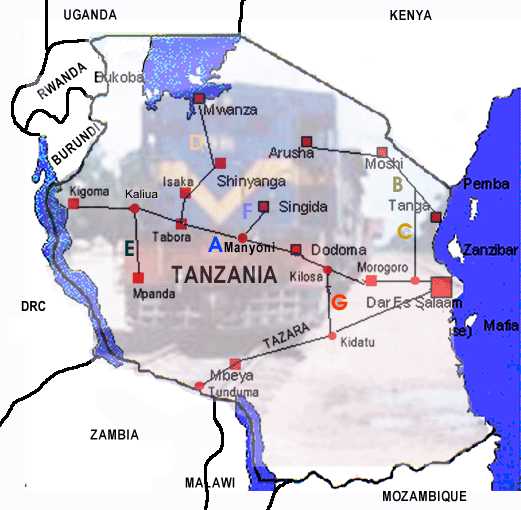
In the morning we had arrived in Dodoma, the congressional capital of Tanzania. We had completed the first third of our trip across Tanzania and everything was going well. The rest of the day was fantastic: the landscapes were beautiful and dynamic, we got a unique look at regional differences in home building, food, and goods, and we started to build friendships with some of the other passengers on the train. Throughout the day, the train made frequent stops to pick up/drop off passengers, to refill fuel tanks (the train ran on diesel), and sometimes for no apparent reason at all. This video is taken in a small village that prepared food for people on the train and sold it through the train windows. I ate “chipsi mayai” which means potato wedges with an egg broken over them and fried. I took this shot as the train started to speed away from the sellers and their food stands.
That evening, the mood changed quickly when one of the workers on the train told us they had gotten word that a cargo train ahead of us the track had capsized. Although nobody was hurt, several train cars had fallen off the rails, and the railway had been damaged. We would be delayed indefinitely. Night set in and the train proceeded to Tabora—the biggest town before the accident on the rails. We would spend the night in Tabora and they would give us more information in the morning. Morning rolled around and we all sat in the hot train awaiting their announcement. However, the announcement was only that there would be another announcement in the evening. To us American students, this was frustrating, but the East Africans on board seemed not to care. To them, this seemed normal, out of their hands, not worth fretting about. Mungu akitaka (God’s wishes). Evening rolled around and they gave us another announcement: workers were fixing the problem and another announcement would come in the morning…It seemed certain that this would drag on indefinitely…
During our unexpected stay in Tabora, our train sat idly at the Kigoma train station. There are some important differences between our train when it was in motion and our train when it was stopped, and I’d like to explain them. While moving, the train drew air through the windows and the circulation of the air provided some relief from the hot, stuffy cabin air. However, when the train was still, there was no such circulation. At one point, the train died momentarily while struggling to climb a hill. When we subsequently rolled to a stop, I felt beads of sweat form on my brow instantaneously. One Tanzanian man in the cabin next to ours said it well: “tuposimama, tuchemsha,” which means, “when we are still, we boil.” To protect our belongings, one person had to stay in each train cabin at all times and they boiled.
While one person sat boiling in the train cabin, the others got to explore Tabora town. Not sure what to do in a small town like Tabora, we looked it up in our travel guide. Guess what was listed as a key attraction? THE TRAIN STATION. Having spent plenty of time at the train station, we just decided to get out and explore the town on foot. In town, we found some good restaurants, met some interesting people working on water issues in East Africa, and even enjoyed cold beverages in the shade. But on returning to the train, another difference between a stopped train and a moving train became apparent: the smell.
The train toilets were nothing more than a hole in the bottom of the floor, straight through to the ground. There was a rule (a very good rule) that while the train is stopped, train bathrooms were off limits. However, this rule was rarely followed, and after 48 hours of being delayed in Tabora, the train sat in its own filth and the stench could be smelled for kilometers.
The morning after our second night in Tabora, we finally got some good news: the cargo train had been removed and the railway was almost fixed. The conductor planned to pull out of the station that night at 7:00 pm. Wagers were placed on what our true departure time would be, but to our surprise, the train left at exactly 7:02 pm. We slowly pulled away from the train station, away from the stench. And the air began to circulate again. However, that night, in addition to the threat of thievery, we also feared the rail itself. Where had that cargo train fallen off the rails? Had they repaired the rails thoroughly? To make it worse, the rail over this portion of the journey was even rougher than it had been. Again, nobody slept much.
The next morning we woke up in the Kigoma region. Outside, the landscape looked more familiar to me: mango trees, banana plantations, dark red soil, and rolling hills. We were descending to the shores of Lake Tanganyika. The train pulled around one corner and we finally saw the lake in the distance. I had thought about Lake Tanganyika almost every day for the last year. It was good to see it again.
Believe it or not, those 5 days on the train were some of the best I had ever spent in Tanzania. I made some really good friends. I got a chance to explore parts of Tanzania that I had not expected. And I got to see the Tanzanian countryside in a way that I had never seen it before. I guess they say that travelling isn’t about the destination, it is about how you get there.

Ben! Hello from Madison! I've been reading your blog when I have time, and I am always fascinated by the videos you posted. Thanks for providing visual aids :)
ReplyDeleteI hope that everything is going well for you in Tanzania!